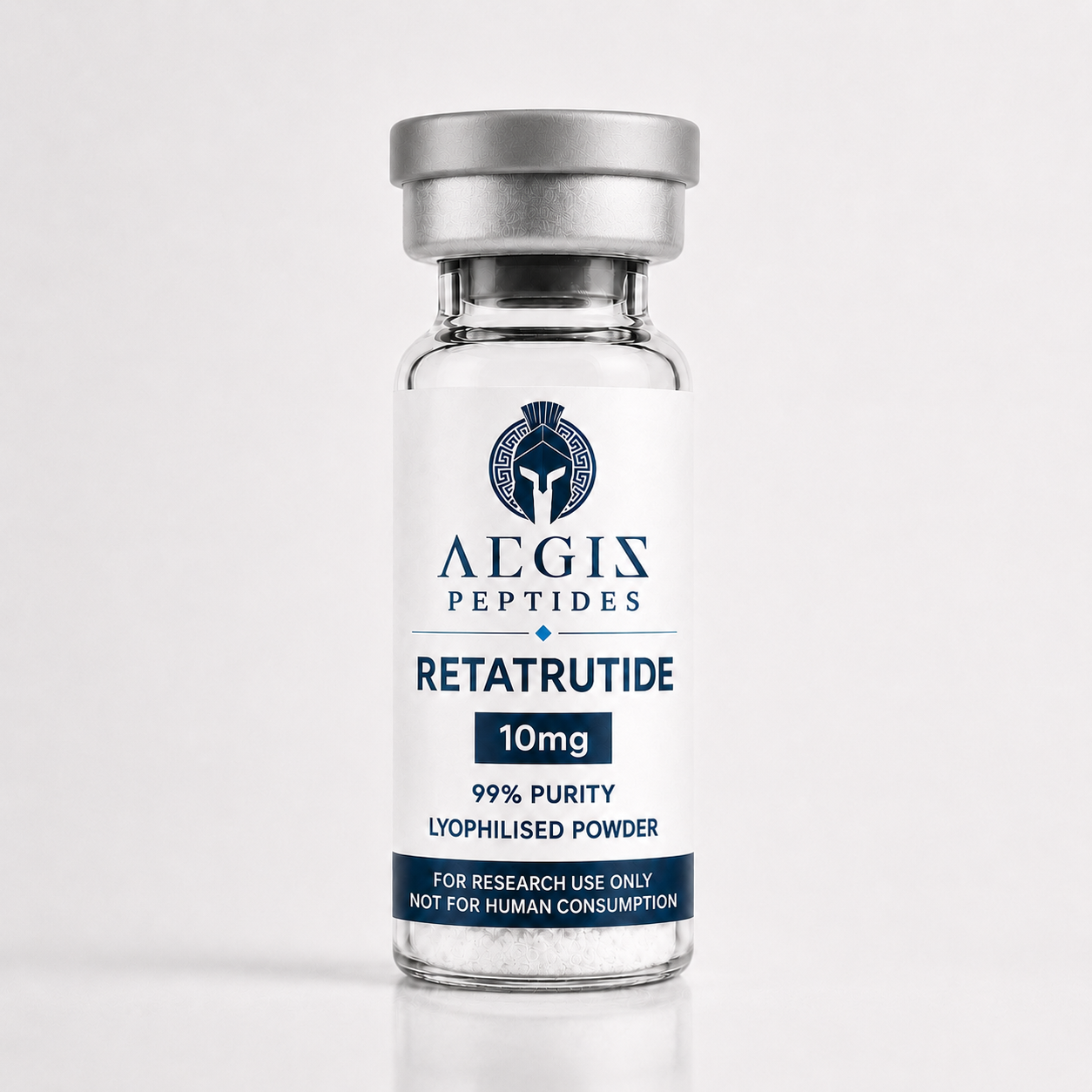
Retatatrutide vs Tirzepatide
Retatatrutide vs Tirzepatide is an increasingly searched comparison within peptide, metabolic and pharmaceutical research. Both compounds are discussed in relation to incretin-based pathways, body-weight research and metabolic signalling, but they are not the same. Tirzepatide is a dual GIP and GLP-1 receptor agonist used in licensed medicines in certain clinical settings, while Retatrutide is an investigational triple receptor agonist studied across GIP, GLP-1 and glucagon receptor pathways.
Aegis Peptides is a UK supplier of research peptides. Our products are supplied strictly for laboratory research use only and are not intended for human consumption, clinical use, veterinary use, food use, cosmetic use or therapeutic use. This page is for educational and research-focused information only. It is not medical advice, dosage guidance or a recommendation for personal use.
What Is Retatrutide?
Retatrutide is an investigational peptide-based compound studied for its activity across three receptor pathways: GIP, GLP-1 and glucagon. Because of this triple receptor profile, Retatrutide is often discussed in scientific literature as a triple-hormone-receptor agonist.
These pathways are relevant to metabolic research because they are connected to appetite signalling, glucose regulation, energy balance and body-weight regulation in controlled study environments.
What Is Tirzepatide?
Tirzepatide is a dual GIP and GLP-1 receptor agonist. It is widely discussed in clinical and pharmaceutical research and is also the active ingredient in licensed medicines used in certain prescribed settings.
The key point is that Tirzepatide targets two incretin-related receptor pathways, while Retatrutide is studied across three receptor pathways.
Retatatrutide vs Tirzepatide: Key Difference
The main difference between Retatatrutide vs Tirzepatide is receptor activity.
Tirzepatide acts on:
- GIP receptor pathway
- GLP-1 receptor pathway
Retatrutide is studied across:
- GIP receptor pathway
- GLP-1 receptor pathway
- Glucagon receptor pathway
This additional glucagon receptor activity is one reason Retatrutide has attracted research interest. However, more receptor activity does not automatically mean a compound is safer, better or suitable for personal use. Scientific comparisons must be based on controlled research data.
Weight Loss Study Data: Retatrutide
In a phase 2 obesity trial published in the New England Journal of Medicine, Retatrutide produced substantial body-weight reductions over 48 weeks. The 12 mg Retatrutide group showed mean body-weight reduction of up to 24.2% at 48 weeks, compared with 2.1% for placebo.
The same study reported that, at 48 weeks, among participants receiving 12 mg Retatrutide:
- 100% achieved at least 5% body-weight reduction
- 93% achieved at least 10% body-weight reduction
- 83% achieved at least 15% body-weight reduction
These figures are from controlled clinical research and should not be interpreted as personal-use guidance.
Weight Loss Study Data: Tirzepatide
In the SURMOUNT-1 trial, Tirzepatide was studied over 72 weeks in adults with obesity or overweight without diabetes. Reported average body-weight reductions were:
- 16.0% with 5 mg Tirzepatide
- 21.4% with 10 mg Tirzepatide
- 22.5% with 15 mg Tirzepatide
- 2.4% with placebo
The study also reported that 63% of participants receiving 15 mg Tirzepatide achieved at least 20% body-weight reduction, compared with 1.3% for placebo.
Retatatrutide vs Tirzepatide: Comparing Weight Loss Figures
When comparing Retatatrutide vs Tirzepatide, the figures often discussed are Retatrutide’s 24.2% mean weight reduction at 48 weeks in the 12 mg group and Tirzepatide’s 22.5% mean weight reduction at 72 weeks in the 15 mg group.
However, this is not a direct head-to-head trial. The studies had different designs, durations, dosing structures and participant groups. This means the figures should be compared cautiously. A higher percentage in one trial does not automatically prove superiority in all settings.
Side Effects of Retatrutide
In Retatrutide research, the most commonly reported adverse events were gastrointestinal. These were described as dose-related and mostly mild to moderate in severity.
Commonly discussed Retatrutide side effects include:
- Nausea
- Diarrhoea
- Vomiting
- Constipation
- Indigestion or acid reflux
- Abdominal discomfort
- Reduced appetite
- Skin sensitivity or altered skin sensation in some research discussions
The Retatrutide phase 2 trial also reported dose-dependent increases in heart rate, which peaked at 24 weeks and then declined.
Side Effects of Tirzepatide
In SURMOUNT-1, Tirzepatide’s most common adverse events were also gastrointestinal and were generally mild to moderate, often occurring during dose escalation.
Reported side-effect rates included:
- Nausea: 24.6% with 5 mg, 33.3% with 10 mg and 31.0% with 15 mg
- Diarrhoea: 18.7% with 5 mg, 21.2% with 10 mg and 23.0% with 15 mg
- Constipation: 16.8% with 5 mg, 17.1% with 10 mg and 11.7% with 15 mg
- Vomiting: 8.3% with 5 mg, 10.7% with 10 mg and 12.2% with 15 mg
For comparison, placebo rates were 9.5% for nausea, 7.3% for diarrhoea, 5.8% for constipation and 1.7% for vomiting.
Retatatrutide vs Tirzepatide: Side Effect Comparison
Both Retatrutide and Tirzepatide are associated with gastrointestinal side effects in research and clinical trial settings. Nausea, diarrhoea, vomiting and constipation are common themes across both compounds.
The main difference is that Retatrutide’s triple receptor activity may create a different safety and tolerability profile that is still being evaluated in ongoing research. Tirzepatide has a broader clinical development and prescribing background, while Retatrutide remains investigational.
Why Research Context Matters
Searches for Retatatrutide vs Tirzepatide often focus on weight loss, side effects and perceived strength. However, research data should never be treated as self-use advice.
Clinical trials involve:
- Participant screening
- Controlled dosing protocols
- Professional monitoring
- Adverse event reporting
- Structured study conditions
This is very different from unsupervised personal use. Anyone with health concerns should speak to a qualified healthcare professional.
Aegis Peptides: UK Research Peptide Supplier
Aegis Peptides supplies research peptides for laboratory research use only. We do not provide medical advice, dosage guidance, injection instructions or personal-use recommendations.
Our products are not intended for:
- Human consumption
- Self-administration
- Weight-loss use
- Clinical treatment
- Veterinary use
- Cosmetic use
- Food or supplement use
- Therapeutic use
Aegis Peptides supports research-focused buyers with clear product information, responsible wording and free UK delivery.
Frequently Asked Questions About Retatatrutide vs Tirzepatide
What is the main difference between Retatrutide and Tirzepatide?
The main difference is receptor activity. Tirzepatide targets GIP and GLP-1 receptor pathways, while Retatrutide is studied across GIP, GLP-1 and glucagon receptor pathways.
Which showed greater weight loss in studies?
Retatrutide showed up to 24.2% mean body-weight reduction at 48 weeks in a phase 2 trial, while Tirzepatide showed up to 22.5% mean body-weight reduction at 72 weeks in SURMOUNT-1. These were separate studies, so the figures should not be treated as a direct head-to-head comparison.
Do Retatrutide and Tirzepatide have similar side effects?
Both are associated with gastrointestinal side effects in research and clinical settings, including nausea, diarrhoea, vomiting and constipation.
Is Retatrutide approved for personal use?
Retatrutide is widely discussed as an investigational compound. Products supplied by Aegis Peptides are strictly for laboratory research use only and are not for personal use.
Can Aegis Peptides provide dosage advice?
No. Aegis Peptides does not provide dosage guidance, administration advice, injection instructions or medical recommendations.
Final Thoughts
Retatatrutide vs Tirzepatide is an important comparison in modern peptide and metabolic research. Tirzepatide is a dual GIP and GLP-1 receptor agonist with published phase 3 data, while Retatrutide is an investigational triple receptor agonist studied across GIP, GLP-1 and glucagon pathways.
Both compounds have produced notable body-weight reductions in controlled studies, and both are associated with gastrointestinal side effects. However, these findings must be interpreted carefully and should not be used as personal-use guidance.
Aegis Peptides supplies research peptides strictly for laboratory research use only, with clear product information, responsible positioning and free UK delivery.